


AI is evolving rapidly, and new buzzwords seem to appear weekly. ‘Agentic AI’ may feel like just another term, yet it’s key for teams aiming to use AI practically.
In this short blog post, we’ll break down what agentic AI is, how to prepare your data for it, and how that differs from working with generative AI, machine learning, or traditional analytics.
What is Agentic AI and its data needs?
Agentic AI refers to systems that don’t just predict or generate outputs – they plan, make decisions, act autonomously toward a goal, and adapt based on the environment. Think autonomous agents, not just smart tools. We’re now seeing a wave of these systems entering the market as personal AI assistants, co-pilots, and even autonomous robots – not of the terminator kind, but practical tools designed to operate with more independence and initiative in everyday tasks. With that in mind, the key difference in its data needs is that it’s not as simple as input equals output. It requires the following:- Goal-Oriented Data: Data should define goals, success criteria, and context for decision-making to ensure agents understand why they act, not just how.
- Environment Simulation: Agents need clear, structured representations of their environment (i.e. states, actions, and consequences) to handle complex real-world conditions.
- Temporal and Sequential Data: Agents need temporal data to capture sequences, state changes, and long-term causes and effects to help them plan, anticipate, and adapt.
- Dynamic and Real-Time Data: Agentic systems rely on real-time, evolving data streams to adapt to dynamic environments and support responsive decision-making.
- Feedback Loops: Data should capture feedback loops that help agents learn and adapt by linking actions, outcomes, and future behaviour.
Key Differences in Data Prep and Modelling
When preparing data for agentic AI, the fundamental shift is that you’re not just feeding information for pattern recognition or content generation – you’re enabling autonomous decision-making in dynamic environments.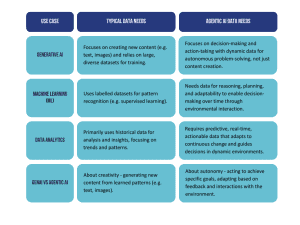
Key Challenges for Agentic AI Data
Preparing data for agentic AI may resemble traditional AI workflows on the surface, but it involves a far more intricate set of challenges. Unlike traditional systems, agents are designed to act independently, learn through interaction, and adapt to evolving environments. As a result, there are three key challenges that make preparing data for agentic AI fundamentally different:- Context Sensitivity: Agents must understand evolving contexts – meaning you may need to model the world, not just facts.
- Exploration vs Exploitation: Data must allow for discovery, not just execution.
- Sparse Rewards: Real-world feedback may be rare, noisy, or delayed – so training data must account for long-term outcomes.


